
Article 50 of the EU AI Act requires you to tell people when they’re talking to a bot, when content is AI-generated, and when a deepfake is a deepfake — in every language you operate in, with the exact wording placed in the right spot. Get it wrong, and the fine reaches €15 million or 3% of global turnover. Most businesses either skip this entirely or spend hours drafting notices from scratch, language by language. This guide does that work for you.
WHAT’S INSIDE
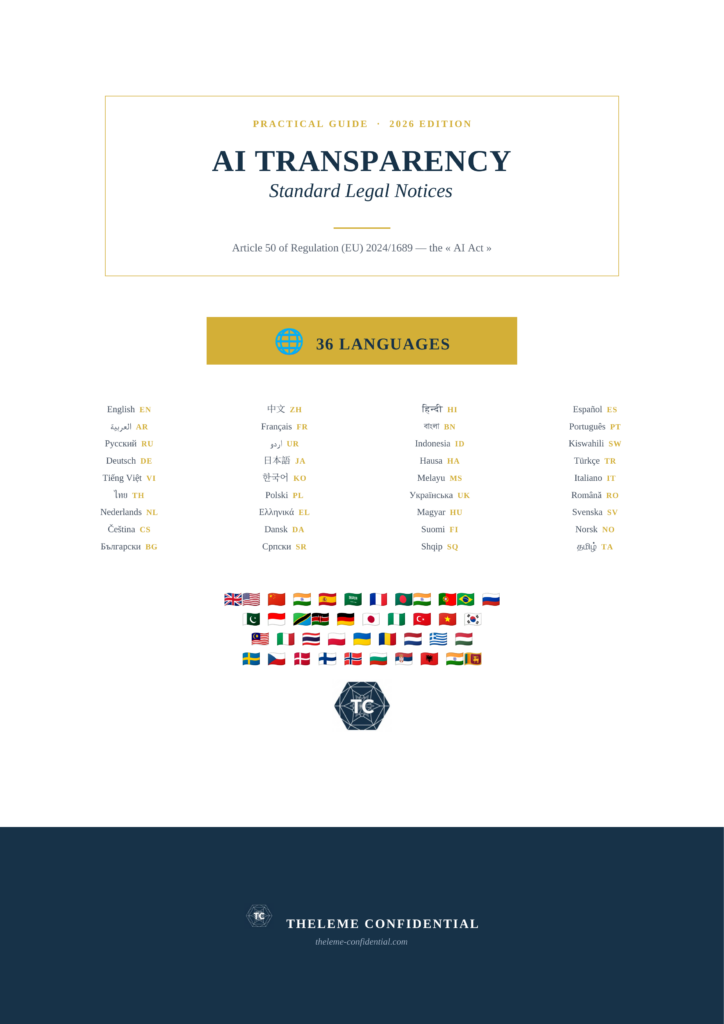
7 standard notice types (M1–M7), covering every AI Act Article 50 scenario: chatbots, transactional AI agents, synthetic content, deepfakes, public-interest text, emotion/biometric recognition, and internal use — Each notice includes: the legal basis, ready-to-use wording, where to place it, and the applicable exceptions — Full coverage in 36 languages, led by English, ordered by number of speakers worldwide — including all major EU languages, key trading-partner languages, and diaspora languages (Bulgarian, Serbian, Albanian, Tamil) — A dedicated section on what does NOT satisfy the law — the mistakes most companies make (burying notices in T&Cs, vague technical language, non-contextual disclosures) — Clickable-free, print-ready PDF with a full table of contents, 36-language cover reference, and page navigation
WHO IT’S FOR
Agencies, SaaS companies, e-commerce businesses, and consultancies operating across multiple EU markets — anyone who needs to paste compliant AI transparency notices into a product, a website, or a client deliverable without hiring a translator for each language.
WHY IT MATTERS
A notice that isn’t visible at the point of interaction, or that’s only in your CGU/privacy policy, doesn’t satisfy Article 50 — even if you meant well. This guide gives you the exact formulation regulators expect, already translated, already placed correctly. Format: PDF, 76 pages. Instant download after purchase. This guide reflects European Commission guidance available at the time of writing and does not constitute legal advice.
Charlotte W. –
We generate client visuals with AI tools and never had a compliant way to label them. The deepfake disclosure wording in this guide is now baked into every deliverable we ship. Charlotte W. — Operations Director, Marketing Agency (United Kingdom) · 78 employees
Javier M. –
Our booking assistant runs in Spanish and English. The Article 50 templates gave us wording our lawyer actually approved on the first read — no back and forth. Javier M. — Managing Director,Hospitality Group (Spain) · 35 employees
Dimitar P. –
We sell across five EU countries and translating our AI chatbot disclosure ourselves would have taken weeks. Having it ready in Bulgarian, plus every other language our customers use, meant we just copied and pasted. Dimitar P. — Founder, Software Development Studio (Bulgaria) · 15 employees